A chauffeur is not simply a driver. The distinction is professional, contractual, and visible in every detail of the service — from the vehicle presented to the non-disclosure agreement signed before the first journey. For executives and their assistants planning ground transport in Brussels, understanding the difference is the first step to arranging the right service.
The Core Distinction: Service Level, Not Job Title
Why the Terminology Matters
Both a chauffeur and a driver operate a motor vehicle. That is where the similarity ends. A driver completes a journey — picking up a passenger and delivering them to a destination. A chauffeur manages a travel experience: anticipating the client’s needs, maintaining a briefed understanding of their preferences, and ensuring that nothing in the journey requires the client’s attention.
The practical difference is most visible when something changes. A driver waits at the kerb. A chauffeur monitors the flight, adjusts automatically, and has the vehicle positioned before the client exits arrivals — with no call, no text, no instruction required from the passenger.
Training and Professional Standards
What Chauffeur Training Actually Covers
A professional chauffeur is selected through a more rigorous process than a standard driver. At Belvedere Limousines, the selection criteria include:
- Presentation — dark formal suit, polished shoes, white gloves available on request; appearance maintained throughout the engagement
- Language — full fluency in English as standard; most international visitors to Brussels arrive from London, New York, Geneva, or the Gulf and require no language barrier at any point
- Discretion training — briefing on protocols at EU institutions, NATO Headquarters, private aviation terminals, and Brussels’ five-star hotel concierge standards
- Local knowledge — navigation of the EU Quarter, security access procedures at Berlaymont and Justus Lipsius, parking at Sofitel Louise, the Wiltcher’s, and Stanhope without direction from the client
- Non-disclosure agreement — signed as standard; destinations, companions, conversations, and schedules are confidential
A driver hired through a ride-share application has passed a background check and a driving test. A chauffeur has been trained to serve at a level where the client never needs to think about logistics.
The Vehicle: Why It Matters
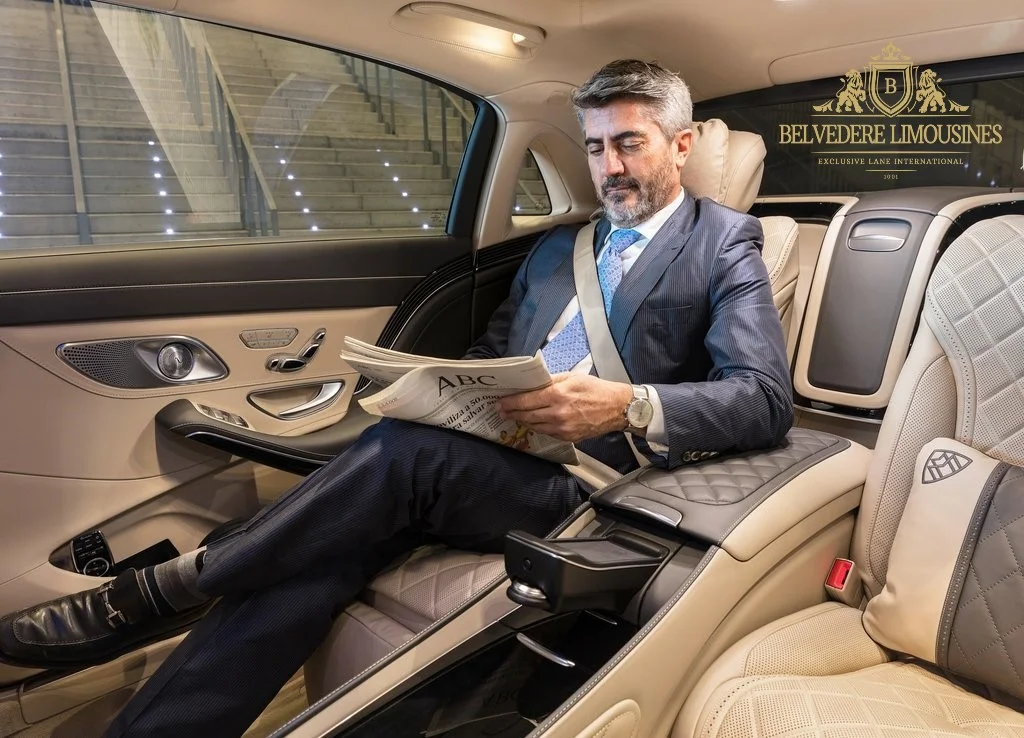
A driver can operate any vehicle. A chauffeur service almost always means a luxury vehicle — not by convention, but because the vehicle is part of the service. The condition of the car, the cleanliness of the interior, the temperature on arrival, and the availability of phone chargers, water, and Wi-Fi are all part of what a chauffeur provides.
The Belvedere Limousines fleet in Brussels is entirely Mercedes-Benz: S-Class, Maybach S-Class, V-Class for groups, and Sprinter for larger parties or luggage-heavy arrivals. Every vehicle arrives with a fresh interior, climate pre-set, and every detail prepared before the client enters. The vehicle is never older than current specification.
Continuity: The Same Person, Every Time
The Retained-Driver Model
One of the clearest differences between a driver and a chauffeur is continuity. A ride-share or taxi provides whoever is available. A chauffeur service assigns the same professional for the duration of the engagement.
For executives on multi-day visits to Brussels, this means:
- The same person at arrivals on day one is the same person outside the Wiltcher’s on day two and day three
- No need to re-explain preferences, re-enter destination addresses, or re-brief on schedules
- A chauffeur who already knows that the client takes coffee at pickup, prefers silence on morning journeys, and requires a name board at BRU Arrivals Hall B
- A single point of accountability — if something is not right, the same relationship exists to address it
For executive assistants managing senior principals, this continuity is not a luxury — it is a requirement. A principal who returns to Brussels four times a year should not have to manage their ground transport from scratch on each visit.
Accountability and Contractual Standing
A driver hired through an application is a contractor to a platform. A chauffeur retained through a professional service operates under a commercial agreement with defined terms, non-disclosure obligations, cancellation policies, and a named account manager.
For corporate travel managers and family office administrators, this matters enormously. There is a vendor to invoice, a manager to contact, and a relationship to hold accountable — not a support chat window and an anonymous rating system.
At Belvedere Limousines, every corporate client receives a dedicated account manager, consolidated monthly invoicing in EUR, GBP, or USD, and a direct telephone contact available 24 hours a day.
When to Use a Chauffeur vs a Driver
There are situations where a standard driver or taxi is perfectly adequate — a quick hop across the city, an informal errand, an airport run at 5am with no meetings attached. The chauffeur standard is designed for contexts where the stakes of the journey are higher:
- Executive travel with a full day schedule — where the driver needs to understand the itinerary, not just the next address
- Private aviation arrivals — where FBO terminal access, name boards, and tarmac-side coordination are required
- Diplomatic or institutional movements — where protocol, discretion, and access familiarity are non-negotiable
- Multi-day retained service — where a single consistent relationship across the length of a Brussels visit is the appropriate model
- High-profile guests at leading hotels — where the concierge has recommended a specific provider and the standard must match the hotel’s own
For any of these situations in Brussels, a retained private chauffeur with Belvedere Limousines provides the appropriate level of service. For corporate accounts requiring regular executive ground transport, a standing arrangement removes the need for per-visit booking. All Belvedere chauffeurs sign NDAs and are fully briefed before first contact with a client.