For business travel from Brussels to Paris, Amsterdam, or Frankfurt, an executive has three options: the Thalys or Eurostar, a short-haul flight, or a chauffeur. The train wins on raw time. The flight wins nothing outright once you add the terminal wait. The chauffeur wins on productivity, privacy, and door-to-door continuity — and, more often than executives expect, on total cost. This is a working comparison for corporate travel coordinators.
The Three-Way Comparison — Door-to-Door Time
Door-to-Door Times per Route
The most common mistake in evaluating cross-border travel is to compare mode-to-mode times: "the Thalys takes 1h20 so I'll take the train." Door-to-door reality is different. Below is the working comparison Belvedere shares with corporate travel coordinators.
| Route | Chauffeur (D2D) | Train (D2D) | Flight (D2D) |
|---|---|---|---|
| Brussels → Paris | ~3h | ~2h30 (Thalys/Eurostar + station transfers) | ~4h30 (BRU-CDG including check-in + terminal transfer) |
| Brussels → Amsterdam | ~2h30 | ~3h (Thalys + station transfers) | ~4h (BRU-AMS including check-in + Schiphol transfer) |
| Brussels → Frankfurt | ~4h | ~4h (ICE via Cologne + station transfers) | ~4h (BRU-FRA including check-in + terminal transfer) |
Numbers are indicative and assume central-Brussels origin (a five-star hotel on Avenue Louise) to central destination (a hotel or meeting near the city core). Airport variants at either end add time to the flight; suburban origins shift the calculus toward the chauffeur.
Where the Chauffeur Wins — and Where It Doesn't
When Each Mode Is the Right Call
This is not a "chauffeur is always best" argument. Each mode has legitimate use cases. The comparison below is the working guidance Belvedere provides when asked.
Chauffeur wins for:
- Multi-passenger travel (2+) — per-seat economics flip in favour of the chauffeur, particularly for return-trip retention
- Confidential work en route — NDA-covered dossiers, board materials, negotiation prep that cannot be opened in public seating
- Heavy luggage or equipment — presentation kit, sample cases, wardrobe for multi-day trips
- Multi-city itineraries — Brussels → Paris → Amsterdam without repeating luggage handling and taxi transfers
- Evening returns — no last-train pressure, no missed-flight risk, no rebooking friction
- Multi-stop journeys — picking up a colleague or a client at a hotel en route
- Weather-disrupted travel — rail signalling problems, air traffic strikes, and the general fragility of scheduled transport
Train or flight wins for:
- Solo travel where price is the decisive constraint (business-class Thalys ticket bought in advance beats a one-way chauffeur on cost)
- Travel to a station-adjacent meeting where the last mile is walking distance (Paris Gare du Nord to the 10th arrondissement, for example)
- Environmental accounting — the train is significantly lower carbon on all three routes; some corporates now require this
- Ultra-time-critical single legs where a train departure aligns exactly with a meeting time
The Productivity Case — The Rear Cabin as Mobile Office
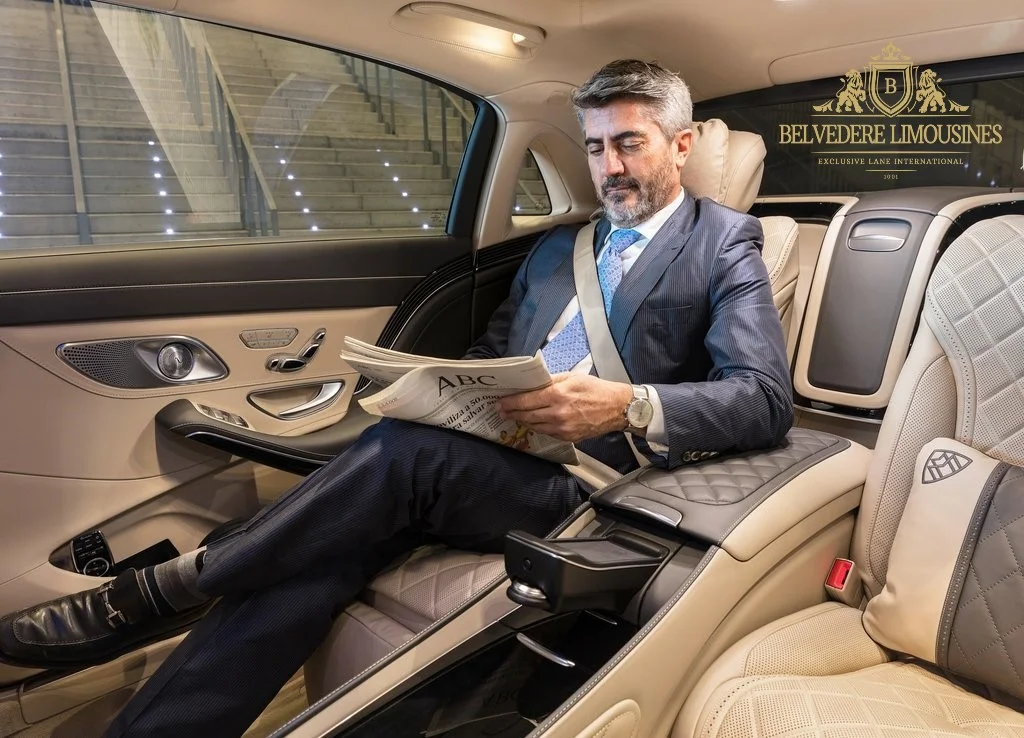
The strongest argument for chauffeured intercity travel is not comfort. It is uninterrupted work. In the rear cabin of a Mercedes-Maybach S-Class or S-Class, an executive has three hours of silent, private, phone-secure working time. Documents can be spread out. Calls can be taken. Video meetings can be conducted. Delegations can hold a strategy discussion with no risk of being overheard.
Thalys business class is comfortable but public. Short-haul business class is public and interrupted. Neither offers a secure environment for a confidential conversation. This is the practical reason board members and negotiating teams increasingly default to the chauffeur for multi-passenger Brussels-Paris-Amsterdam-Frankfurt travel — the vehicle IS the meeting room.
Cost Reality — When the Chauffeur Is Actually Cheaper
Total-Cost by Party Size and Return-Trip Retention
Cost comparison is where most travel coordinators assume the chauffeur loses. Sometimes true, sometimes not — the answer depends on party size, direction (one-way vs return), and whether the journey is booked in advance or on short notice.
For a single traveller, one-way, booked two weeks ahead: train wins on cost every time. For 2–4 passengers on the same journey: the chauffeur is competitive or cheaper (one vehicle vs 2–4 tickets plus 4x taxi transfers at both ends). For return-trip retention where the same driver waits at destination for a day or two: the chauffeur is usually the cheapest total-cost option because there is no double-booking of tickets, no station transfers, and no destination taxi budget.
Belvedere does not publish tariffs (see the corporate account guide for the pricing posture explanation) — but a same-day quote reveals the true trade-off. A phone call is usually the fastest way to find out whether the chauffeur or the train is cheaper for a specific itinerary.
Route-Specific Notes
Per-Destination Guidance
Each of the three main routes has its own idiosyncrasies. Cross-reference the dedicated route pages for full detail: Brussels to Paris, Brussels to Amsterdam, Brussels to Frankfurt.
Brussels → Paris. The Thalys/Eurostar is genuinely competitive for solo travel. But the E40 motorway is well-managed, tolls are pre-paid, and door-to-door in a Maybach S-Class or S-Class runs about 3 hours from central Brussels to central Paris. Chauffeur becomes dominant for multi-passenger travel and return-trip retention.
Brussels → Amsterdam. The chauffeur is competitive on time (~2h30 door-to-door) and dominant on flexibility. AMS Schiphol is manageable but the check-in overhead makes short-haul air travel to Amsterdam almost never worthwhile for executive travel from Brussels.
Brussels → Frankfurt. Longest of the three routes at ~4 hours. Both chauffeur and flight take about 4 hours door-to-door; the chauffeur wins on continuous privacy, no security queues, and door-to-door luggage handling — critical for board-material or NDA-covered dossier travel to financial-services clients in the Frankfurt banking district.
Common Questions
Answers to the questions asked most often by corporate travel coordinators and executive assistants evaluating cross-border transport modes.
Is a chauffeur from Brussels to Paris faster than the Thalys / Eurostar?
On pure city-centre-to-city-centre travel time, the train is faster (~1h20 Brussels-Midi to Paris Gare du Nord vs ~3h door-to-door by chauffeur). But once you add the station wait, transfer to the meeting, potential rebooking friction, and the loss of a private working environment for the return, the door-to-door executive difference narrows considerably — and disappears entirely for delegations, luggage-heavy travel, or evening returns.
When does a chauffeur outperform a flight from Brussels to Amsterdam or Frankfurt?
Almost always for Amsterdam (BRU-AMS air travel is ~4h door-to-door once check-in, security, boarding, taxi at both ends are included; chauffeur is ~2h30 door-to-door). For Frankfurt, chauffeur (~4h) and flight (~4h door-to-door) are competitive on time but the chauffeur wins on continuous privacy.
Can I work productively during a chauffeur transfer?
Yes — this is the primary reason executives choose the chauffeur option. The Maybach S-Class and S-Class rear cabin includes executive tables, Wi-Fi, USB-C charging, near-silent acoustic isolation, and no fellow passengers. It functions as a mobile office for 3–4 hours of uninterrupted work.
What about cost — is a chauffeur cheaper than a flight or first-class train?
For a single traveller on short notice: business-class train is usually cheapest. For 2–4 passengers: chauffeur is competitive or cheaper on all three routes. For return-trip retention (same driver waits at destination): chauffeur is usually the most cost-efficient option overall.
Do you handle multi-city itineraries like Brussels → Paris → Amsterdam → Brussels?
Yes. Multi-city retained chauffeur itineraries are a routine service pattern. One chauffeur, one vehicle, one continuous point of contact from arrival to departure. See the intercity & long-distance hub for route detail.
Book the Intercity Chauffeur
For a same-day quote on a specific Brussels-to-Paris, Brussels-to-Amsterdam, or Brussels-to-Frankfurt itinerary, call +32 2 318 21 00 or use the enquiry form. Provide origin, destination, dates, and passenger count — a written quote is typically returned within one hour with a comparison note on total-cost vs the train or flight equivalent. See the intercity hub for all 12 Brussels-origin routes.